

How to calculate the required radiator output?
When choosing a radiator, it’s not just about style or color – the most important step is calculating the right output to ensure your room stays warm and comfortable.
When selecting a radiator, design and color often take the spotlight, yet the true priority is its heat output. How much power does a specific room actually need? This is one of the most common questions heard at the KRAFTLAGER warehouse when clients search for the right solution.


To determine the required radiator output, you can use a simple calculation: for a 10 m² room with standard 2.6 m ceilings, you’ll need about 100 W per square meter. This means the optimal choice would be a radiator with roughly 1000 W of heating power.
A standard calculation isn’t always exact – room specifics, heating system type, and a home’s energy efficiency can all significantly affect the required radiator output. Let’s look at the main scenarios where the calculation will differ.

Room on the second floor of a private house
On the second floor, some of the heat naturally rises from the floor below, so less output is required. For a 10 m² room with 2.6 m ceilings, around 70 W per m² is enough — meaning a 700 W radiator will provide comfort and efficient heating.

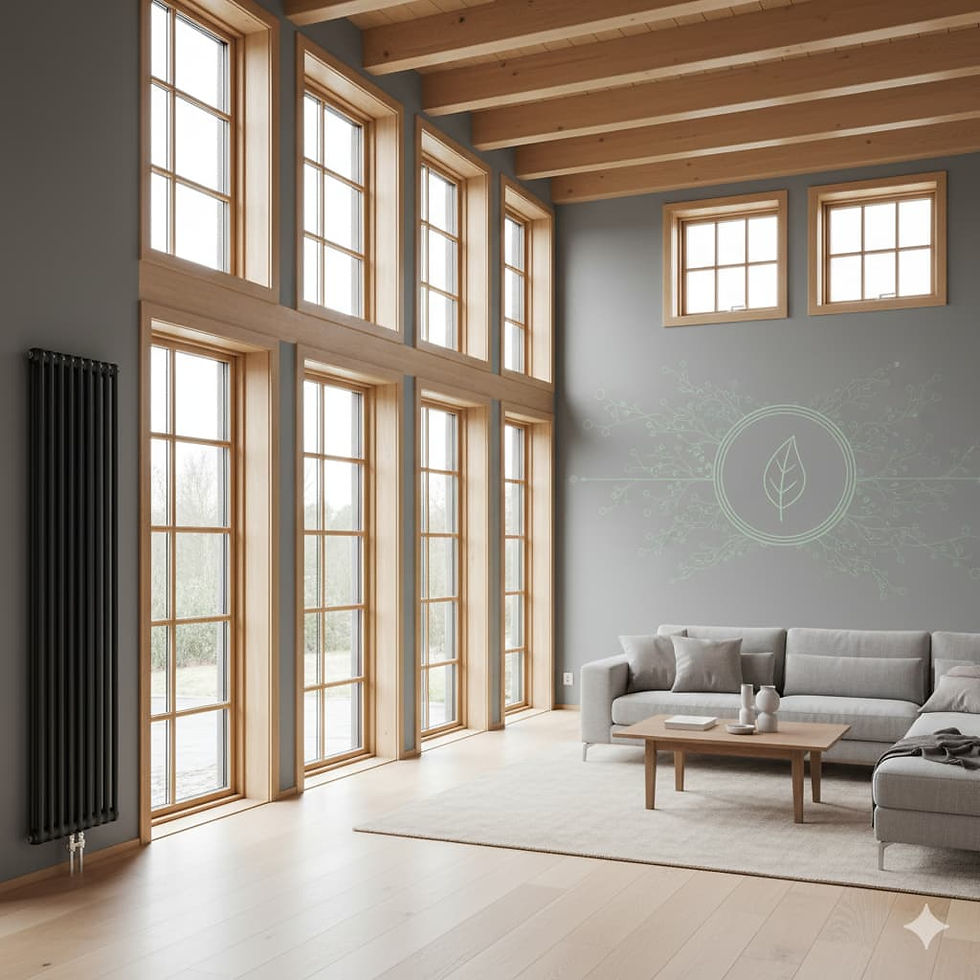
Large windows
Window insulation is usually weaker than solid walls, which leads to higher heat loss. If one wall is fully glazed, you should add +30% to the standard calculation. For a 10 m² room, this means the radiator should deliver around 1300 W of output.
Passive house
A passive house, with its excellent insulation and modern ventilation, requires significantly less heating power. On average, about 50 W per m² is enough. For a 10 m² room, this means a radiator with roughly 500 W output will comfortably do the job.
High ceilings
When ceiling height exceeds the standard 2.6 m, radiator output should be calculated by room volume rather than floor area. Around 40 W per cubic meter is needed to ensure even warmth throughout the entire space.

Heat pump
If the heating system cannot maintain a flow temperature of 50 °C – as is the case with heat pumps that typically supply only around 30 °C – the required radiator size increases. For a 10 m² room, you’ll need about 1800 W to achieve a comfortable indoor climate.
If your home is heated with a solid fuel boiler (pellets, etc.), there’s no need to worry if the radiator you choose has slightly less output than the calculation suggests. Radiator performance is based on a 50 °C system temperature, so on especially cold days comfort can easily be restored by raising the flow temperature. A large reserve isn’t essential — correct installation and adjustment are far more important.
When choosing a radiator, not only design and output matter, but also price. That’s why the KRAFTLAGER warehouse has become a favorite for both businesses and private customers looking for high-quality, distinctive solutions at a fair cost. We strive to keep a wide range of radiators in stock, yet due to strong demand the selection changes daily, and the online store may not always reflect the latest availability. So if you don’t see the model you need online, chances are it’s already waiting on our shelves. Call us, send an email, or visit in person – Brīvības gatve 403.c, Rīga – KRAFTLAGER.

